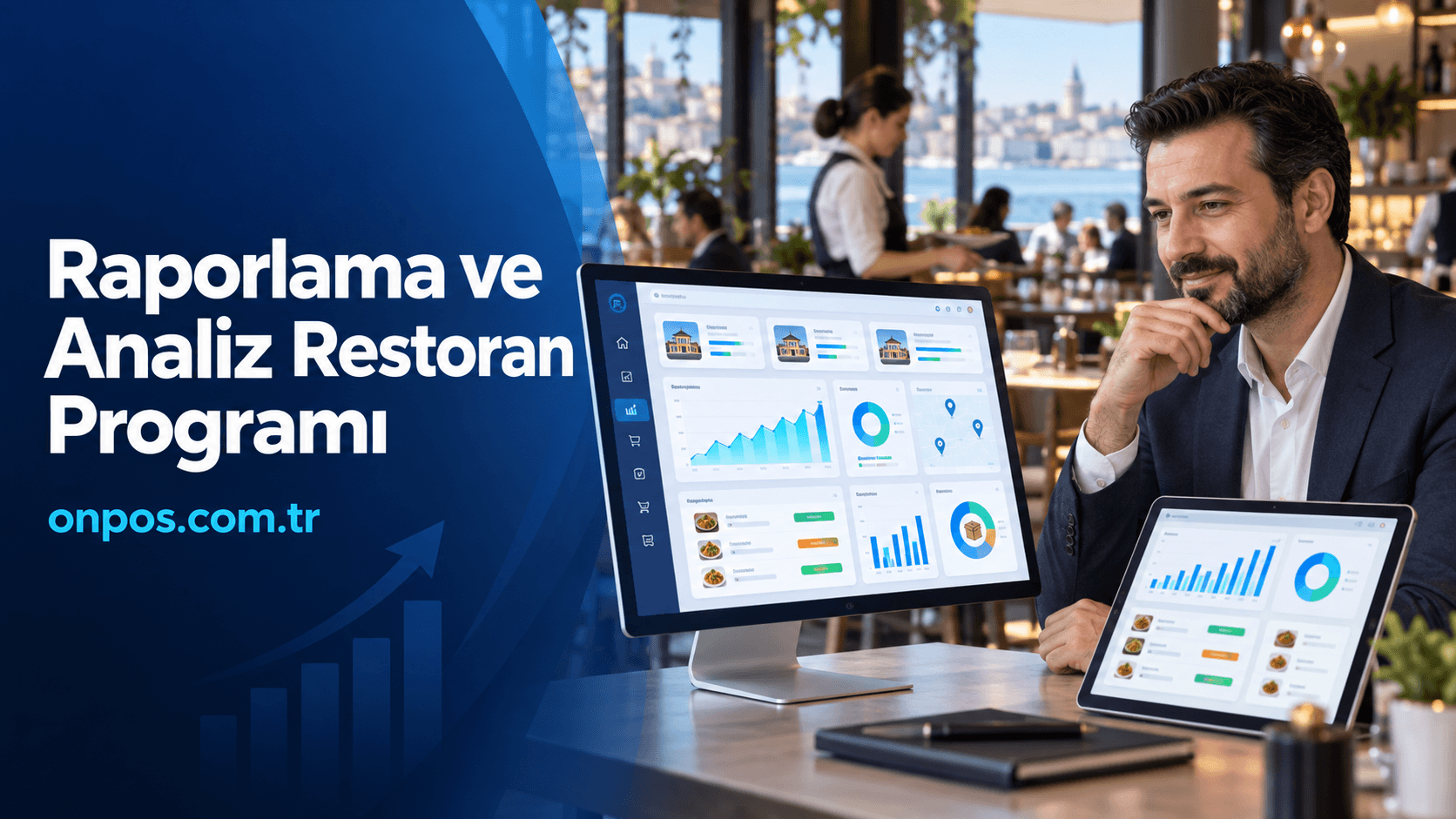
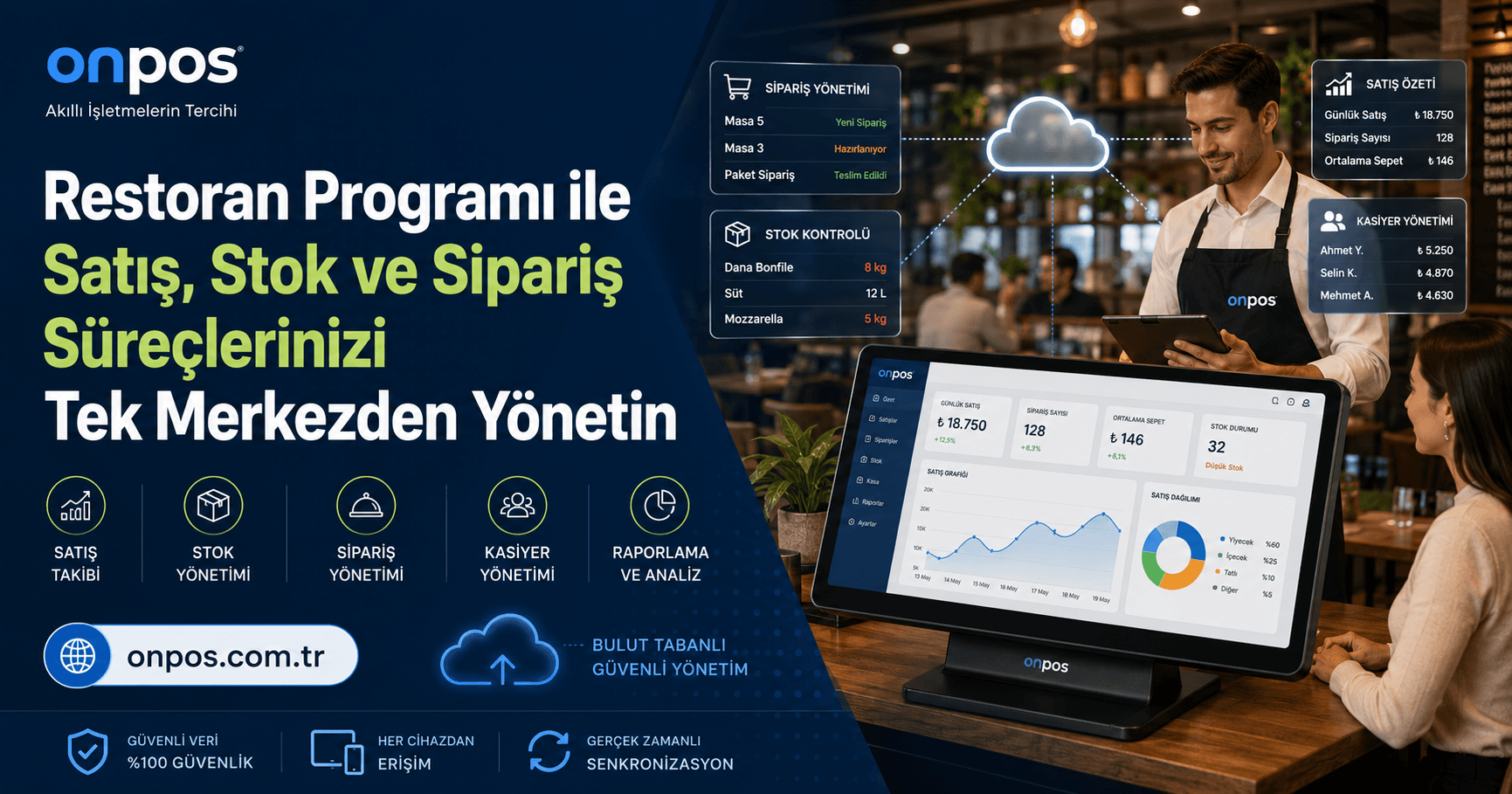
Running a restaurant is not only about cooking good food, being in the right location or offering friendly service. What keeps a business standing at the end of the day is tracking sales correctly, keeping the cash register under control, managing stock on time, letting orders progress without mix-ups and enabling the owner to see the numbers clearly.
Especially in restaurants, cafes, eateries, fast food businesses, patisseries, snack bars and businesses offering delivery, operations run at a high tempo every day. A table order, a delivery call, a payment at the register, the ticket sent to the kitchen, a product that must be deducted from stock and the register check at a shift change are all connected. A disruption in a single link of this chain can turn into both a financial loss and customer dissatisfaction by the end of the day.
That is why restaurant software has become, for today's businesses, much more than just a computer program; it is now an operations hub that helps manage sales, ordering, checks, the cash register, stock, staff and reporting processes in a more organized way.
Business management that relies on ledgers, slips of paper, phone messages, different devices and employees' memory stops being enough at a certain point. As the business grows, the number of tables increases, delivery intensifies and branching comes onto the agenda, keeping control becomes harder. With the right restaurant automation, the owner can make not only the register but the entire operation more visible, measurable and manageable.
Through its solutions for digitalizing the daily operations of restaurants and similar businesses, Onpos Software aims to offer businesses a more organized working model on topics such as sales control, order management, stock tracking, register processes, reporting, delivery, QR menu and multi-branch business management.
What Is Restaurant Software?
restaurant software is a business management solution that helps restaurants, cafes, eateries, patisseries, fast food businesses and companies offering delivery manage their daily operations digitally.
The main purpose of such systems is to be able to track, within a single order, the sales, orders, payments, stock movements, table transactions, delivery records and reporting processes that take place in the business.
Let's think of a simple example:
A customer arrives at the restaurant, sits at a table, places an order, the order is forwarded to the kitchen, the products are prepared, the check is requested and payment is made. From the outside this process looks like a simple service of a few minutes. Yet in the background there are many operations:
-
The order being taken correctly
-
The order being opened on the correct table
-
The products being forwarded to the kitchen completely
-
Cancellations or additions being kept on record
-
The payment being received correctly
-
It being reflected correctly at the register
-
The sold products being linked to stock
-
Them being reported at the end of the day
Running these operations in a scattered way can create serious control problems over time. Restaurant software, on the other hand, makes the different points of the operation more systematic and helps the owner make data-driven decisions.
Restaurant software is not only needed by large restaurant chains. A small neighborhood cafe, a busy eatery, a hamburger place offering delivery, a patisserie, a snack bar or a restaurant group with several branches can also benefit from this kind of digital business management.
Why Should Businesses Use Restaurant Software?
In the early years, many owners can manage the daily process with employees' experience, a register ledger or simple notes. But when the number of customers rises, the product range expands and the team grows, the manual tracking system starts to become an obstacle in front of the business.
Because problems in business management usually do not begin with one big mistake. Small disruptions accumulate over time.
For example:
-
A product can remain open to orders even though it has run out of stock.
-
A discrepancy at the register may not be clearly explained at the end of the day.
-
It may not be possible to track why canceled products were canceled.
-
A delivery order can go to the wrong address or the wrong customer.
-
Table orders can get mixed up during busy hours.
-
Information can be lost during staff changes.
-
At the end of the day the owner may see only the total turnover and miss the real details.
-
Product, price and sales data between branches may not be tracked regularly.
These problems are often accepted as normal on the grounds of “being busy”. Yet with organized restaurant automation, these processes can be made more transparent and traceable.
Detecting register discrepancies earlier
Discrepancies at the register are one of the matters a business owner pays the most attention to. During the day, many collections may take place in cash, by card, by meal card, by online payment or as delivery payments. When these transactions are tracked in different ways, end-of-day accounts take longer and uncertainty grows.
Using restaurant software helps sales and payment movements be tracked in a more organized way. That way, at the end of the day the owner can more comfortably evaluate not only the total turnover but also the distribution of sales by payment type.
Reducing stock loss and unnecessary purchasing
In restaurants, cost often begins in the kitchen. When meat, chicken, cheese, beverages, packaging materials, baked goods, sauces, coffee and consumables are not tracked regularly, the business can buy more products than it needs or face unexpected shortages in critical items.
Stock tracking is not only about answering the question “how many units of a product are left?”. It also helps you understand which product turns over faster, which product sits waiting, which items raise costs and when the purchasing plan should be made.
Reducing order mix-ups
During busy service hours, the wrong table, a missing product, a late transmission to the kitchen or a wrong delivery order directly affects customer satisfaction. Even a restaurant's best dish can lose value in the customer's eyes when it is served incorrectly.
Digital order management supports orders being recorded more regularly and the operation progressing more systematically. It also lets employees work with less dependence on memory, note paper or verbal communication.
Making end-of-day procedures clearer
The end of the day is one of the most important control moments for business owners. But if transactions have proceeded in a scattered way throughout the day, the end-of-day report stops being an evaluation tool and turns into a mere effort to close the accounts.
Thanks to an organized sales, register and reporting infrastructure, the owner can look for clearer answers to these questions:
-
How much was sold today?
-
Which products sold the most?
-
Which payment methods were used?
-
How were delivery sales doing?
-
During which hours was it busy?
-
How did branch-level performance progress?
-
Which products did not show the expected performance?
Making a growth plan before the answers to these questions become clear is not a sound management approach.
What Does Onpos Offer Businesses?
Onpos Software offers digital solutions so that restaurants, cafes, grocery stores, snack bars and similar businesses can manage their different operations in a more organized way. In the restaurant software approach, the main goal is to let the owner follow the daily operation not merely by hearing about it remotely but through data.
Not every business has the same needs. A small cafe's priority may be fast checks and table management. For a restaurant with heavy delivery volume, order and courier processes may come to the fore. A multi-branch company may want centralized reporting and branch control.
For that reason, the right business software must be able to adapt to the business's working order.
A cloud-based usage approach
Cloud-based business software is an important approach that lets the owner reach data without being tied only to the computer at the register.
Even when they are not at the restaurant, the owner may want to track sales, reports, stock status or branch movements. Especially for people who own more than one business, have branches in different cities or cannot be at their business every day, remote access provides a serious management advantage.
Thanks to the cloud-based structure, business management is not condemned to a single physical computer. An approach that provides access to business data through a tablet, a computer or suitable devices makes control more flexible.
Sales and register control
One of the most fundamental duties of restaurant software is to make sales and register processes more organized.
Every transaction made at the register directly affects the business's financial structure. That is why sales, payment types and cancellation and refund transactions must be tracked regularly.
Onpos's restaurant solutions aim to handle core processes such as ordering, payment, stock and customer management within the same structure. That way, at the end of the day the owner can evaluate not on estimates but on more concrete data.
Stock tracking and product control
Stock tracking is not a topic that matters only to grocery stores or corner shops in restaurant businesses. Behind every product sold in a restaurant there are kitchen ingredients, beverages, packaging, consumables and a purchasing plan.
Tracking the stock process regularly can provide these advantages:
-
Noticing critical products before they run out
-
Reducing unnecessary product purchases
-
Examining the causes of shrinkage and waste
-
Planning popular products more accurately
-
Making purchases according to sales movements
-
Managing business costs more consciously
Order management and check organization
In restaurants, order management sits directly at the center of the customer experience. Taking an order late, entering it incorrectly, sending it to the kitchen incomplete or serving it to the wrong table damages the business's reputation.
More orderly check processes can increase staff speed in daily transactions such as table management, adding and removing products, order tracking and settling the check.
Especially during busy hours, a systematic order infrastructure helps employees move within a more organized operation instead of depending on one another.
Tracking delivery and courier processes
In restaurants offering delivery, the operation can be more complex than dining-room service. Orders coming by phone, orders coming through online channels, customer addresses, payment details, preparation time and courier delivery all have to be managed at the same time.
When delivery processes progress in a scattered way, these problems appear:
-
The order being prepared late
-
The wrong product being sent
-
Address details being taken incompletely
-
Not knowing which order the courier is on
-
Collections getting mixed up
-
The customer being unable to learn their order status
Onpos's solutions for courier tracking and delivery processes aim to make order traffic more visible and more manageable.
A more modern customer experience with a QR menu
A QR menu is a digital solution that lets the customer examine products without needing a physical menu. But the real benefit of a QR menu is not only moving the menu onto a screen.
When used correctly, a QR menu:
-
Can make menu updates easier.
-
Can make campaign products more visible.
-
Can provide practicality in price changes.
-
Can help the customer examine products more comfortably.
-
Can support the ordering process.
-
Can answer the expectation of contactless service.
The Onpos QR Menu solution can be evaluated as part of a more holistic digital business approach together with restaurant software.
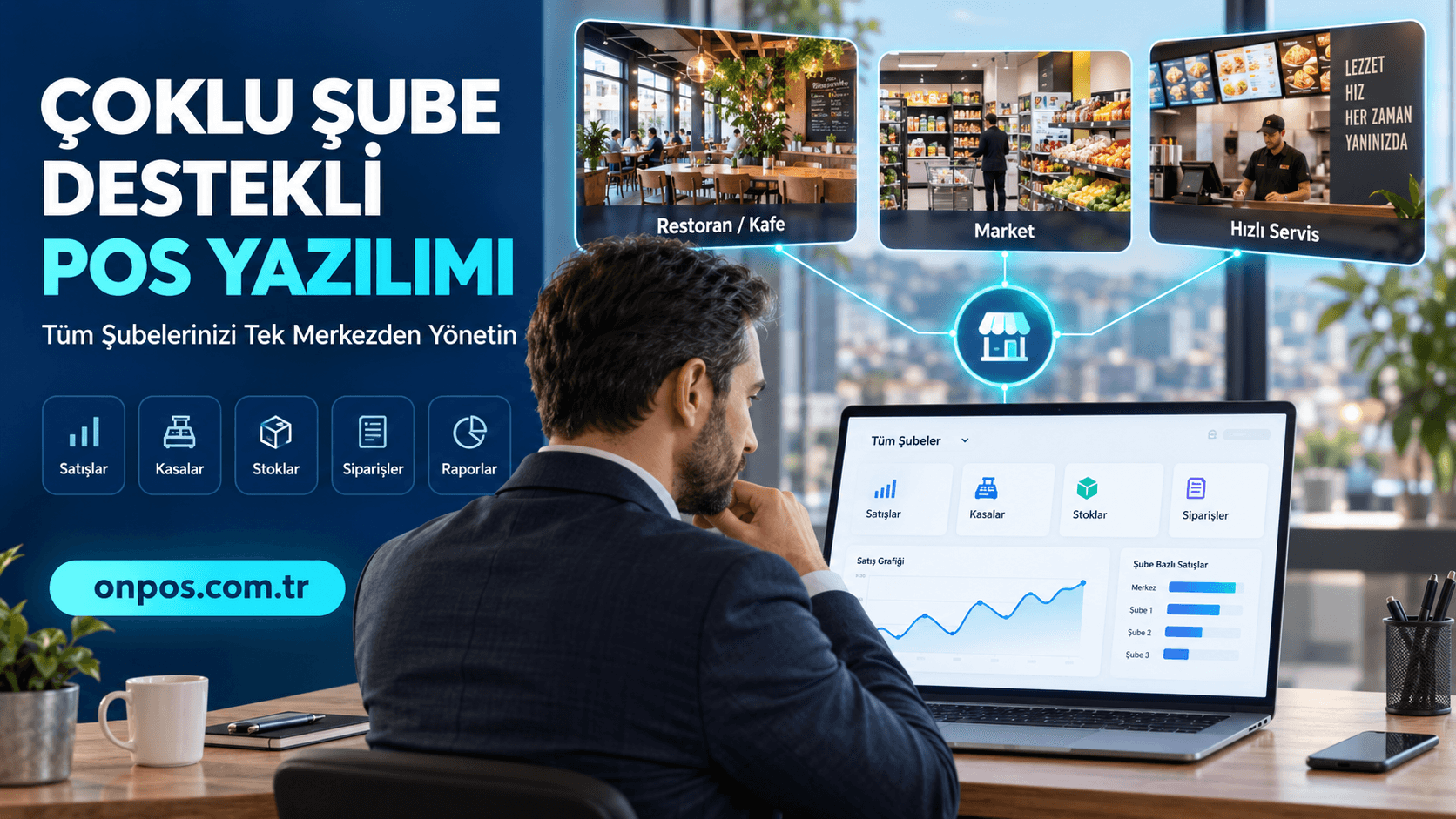
Centralized management for multi-branch businesses
In businesses with more than one branch, the real problem is not making sales. The real problem is being able to establish the same order in every branch.
When different pricing practices, stock differences, register habits and staff errors arise between branches, the owner can lose control as the business grows.
With a centralized management approach, businesses:
-
Can evaluate their branches from a single point.
-
Can compare branch-based sales performance.
-
Can build a more standard structure in price and product processes.
-
Can follow reporting from the center.
-
Can notice operational differences earlier.
Even if this structure is not needed today by small businesses, it can be an important investment for companies that aim to expand into branches in the future.
Which Businesses Is Restaurant Software Suitable For?
Restaurant software is not a system suitable only for large restaurant chains or hotels. It is a structure that can benefit nearly all food and beverage businesses that need daily sales, order, register and stock control.
Restaurants and eateries
Table management, checks, kitchen orders, payment and stock tracking are restaurants' core operations. Especially in businesses with heavy lunch and evening volume, organized restaurant automation can support service speed and operational quality.
Cafes
In cafes, product variety can sometimes be even greater than in restaurants. Product groups such as coffee, hot drinks, cold drinks, desserts, breakfast, snacks and hookah can make order tracking harder.
A cafe software approach can bring order to the business in terms of table tracking, checks, product management and register control.
Fast food businesses
In the fast food sector speed is very important. The customer's order must be taken quickly, prepared correctly and delivered on time. If there is also heavy delivery volume, the operation becomes even more sensitive.
Restaurant software can help the order flow be managed more regularly and reduce the risk of errors during busy hours.
Patisseries and bakeries
Patisseries have different needs due to both retail sales and the production process. Daily product turnover, fast sales, stock control, product groups and register management must be configured correctly.
Especially in patisseries with many products and heavy customer traffic, it matters that sales tracking and stock control are evaluated together.
Grocery stores, corner shops and snack bars
In grocery store, corner shop and snack bar businesses, stock moves very fast. A product's sale, price, stock status and profitability must be tracked regularly.
Onpos's grocery store software approach aims to offer a digital management advantage to businesses that want to track sales, register, stock and reporting processes from a single panel.
Businesses offering delivery
For businesses offering delivery, the time between the order being taken and delivered is the main determinant of the customer experience.
Managing details such as courier tracking, the customer address, the order note, the payment method and the delivery time in an organized way can directly affect the business's chance of getting repeat orders.
Multi-branch companies
Centralized data management is of great importance for businesses with more than one branch. Instead of learning each branch's daily performance separately by phone, the owner wants to manage through more regular reporting and control mechanisms.
Real Business Scenarios
1. A small cafe that cannot keep up with orders during busy hours
Let's picture a neighborhood cafe. At breakfast time and in the evening hours the business is quite busy. Waiters take the orders on notes, the employee at the register tries to track the tables and the kitchen struggles to understand which order will be prepared first.
With the old method, order slips can get lost, products can go to the wrong table or checks can get mixed up.
With restaurant software, order, table and payment processes can be run more regularly. That way, even during busy hours the business moves in a more controlled way, the pressure on employees decreases and customer waiting time can be managed better.
2. A grocery store or corner shop suffering stock loss
A grocery store owner notices that some products run out quickly, but cannot clearly track how much movement each product sees. On the one hand the shelf stays empty; on the other, too much is purchased of slow-moving products.
It is hard to solve this problem with manual stock tracking. Because sales, counting, purchasing and price changes are constantly in motion.
Thanks to digital stock and sales tracking, the owner can examine product movements in a more visible way. This also helps them make purchasing decisions in a more controlled manner, improve shelf layout and manage stock cost better.
3. A restaurant with heavy delivery volume
A hamburger restaurant serves both dining-room customers and delivery orders in the evening hours. Orders coming by phone are noted separately, online orders are checked on a different screen and the couriers keep asking “which order is ready?”.
When this structure continues for a long time, orders getting mixed up, delivery times stretching and customer complaints increasing are inevitable.
Tracking delivery, order and courier processes in a more systematic way can help the business pull its delivery operation together. The owner can more comfortably see which order is being prepared, which order has gone out with the courier and in which process a disruption occurred.
4. An owner who cannot go to their business every day
An owner manages two different workplaces at the same time. It is not possible for them to go to every branch every day and check the register. Daily information arrives by phone; yet that information is often incomplete, late or interpreted.
The biggest risk for a business owner is managing the operation by hearsay rather than real data.
A cloud-based business software approach can offer remote access to sales, register, stock and reporting data. That way the owner can decide by looking not only at the sentence “things went well today” but at more concrete data.
5. A company that wants to manage several branches centrally
A restaurant brand is preparing to grow from two branches to five. But every branch uses its own method. In some branches the prices differ, in some stock tracking is weak and in some the end-of-day reports arrive late.
Expanding into branches means growth; yet growth made without establishing a control system can strain the business.
A centralized reporting and multi-branch management approach gives the business the chance to create a standard. Differences between branches are noticed earlier, sales data is compared and management settles onto firmer ground.
Advantages of Cloud-Based Business Management
Cloud-based restaurant software offers more flexible business management than the classic working order tied to a single computer.
The biggest advantage for the owner is that the data does not depend on a single point. The owner may be inside the restaurant, at home, at the office or traveling. What matters is being able to reach the right data with which to follow the pulse of the business.
A cloud-based structure can provide advantages in these areas:
Remote access
The owner can examine business data not only at the moment they are at the register but also from different points with a suitable internet connection.
Centralized control
If there is more than one branch, instead of bringing together information held on different devices and in different people's hands, a centralized management approach can be created.
More organized reporting
More organized reporting of sales, product, payment and branch data helps the owner support their decisions with data rather than guesswork.
Operational visibility
When a problem occurs in the business, it is possible to notice it earlier instead of learning about it days later. For example, a product reaching a critical level in stock, a category whose sales performance is dropping or differences between branches can be followed more clearly.
Adaptability to growth
A business that has a single branch today may open its second branch tomorrow. That is why, when choosing business software, you must think not only of today's needs but also of future goals.
What Should You Pay Attention to When Choosing Business Software?
The choice of restaurant software should not be made only with a “let's buy a register program” approach. Because the wrong system, instead of making the business's work easier, can drag employees into a new confusion.
For the right choice, the following checklist should be evaluated:
-
Is it easy to use?
If the business is working intensely, staff must be able to learn the system quickly. Complicated screens and long transaction steps can cause problems during busy hours. -
Is it suitable for your business's sector?
The needs of restaurant, cafe, grocery store, patisserie and delivery businesses differ. It matters that the software adapts to your business model. -
Does it support sales and register tracking?
Daily turnover, payment types, register movements and end-of-day control must be handled in a way the owner can see clearly. -
Does it meet your stock management needs?
Especially in businesses with many products, stock tracking is the foundation of cost management. Being able to track product movements is an important advantage. -
Does it simplify order and check processes?
Table management, order transmission, check transactions and payment processes directly affect the business's speed. -
Is it suitable for delivery and courier operations?
If you offer delivery, order, address, payment and courier processes must progress in an organized way. -
Is the reporting sufficient?
Seeing only the end-of-day turnover is not enough. You must be able to reach details such as product, hour, payment type, branch and sales performance. -
Does it offer remote access?
The owner may not be at the register every day. A suitable cloud-based infrastructure provides a strong advantage in terms of remote tracking. -
Is it compatible with a multi-branch structure?
Even if you have a single branch today, if you have a growth goal, a need for centralized management may arise later. -
How is the technical support and training approach?
Post-installation support matters as much as the software itself. You should not be left alone with a technical problem while the business is working intensely. -
Can it answer the business's long-term needs?
When choosing software, you must evaluate not only today's sales order but also future needs such as delivery, QR menu, branching, reporting and staff management.
Frequently Asked Questions
What does restaurant software do?
Restaurant software is a digital business solution that helps manage order, check, sales, payment, register, stock, delivery and reporting processes in a more organized way. The aim is to let the owner make the operation more visible and controllable.
Which businesses is restaurant software suitable for?
It can be suitable for restaurants, cafes, eateries, fast food businesses, patisseries, snack bars, grocery stores, corner shops, businesses offering delivery and multi-branch companies.
What is the advantage of using cloud-based business software?
Cloud-based business software can provide remote access to business data through suitable devices. This also helps the owner track sales, stock and reporting processes at times when they are not at the business.
Can stock and register tracking be done from the same system?
Suitable business software can help manage sales, stock and register processes in a connected way. That way the owner can track data more regularly without having to switch between different ledgers, spreadsheets or applications.
Is restaurant software suitable for multi-branch businesses?
Yes. Especially for multi-branch businesses that need centralized reporting, branch-based sales comparison, product and price control and remote access, digital management systems can provide an important advantage.
Can the owner track sales remotely?
In restaurant software with a cloud-based working approach, the owner can examine sales, report and operation data remotely with devices that have a suitable internet connection.
How do I request an Onpos demo?
Businesses that want to evaluate Onpos's restaurant software and business management solutions can get information about solution options suitable for their own working order by making a contact or demo request through onpos.com.tr.
Time to Manage Your Restaurant by Data, Not Guesswork
Managing a restaurant, cafe, grocery store or delivery business is not only greeting customers and selling products. Real management is seeing where sales go, controlling the register, reducing stock loss, organizing orders, tracking staff processes and planning the business's future correctly.
Manual tracking methods can work for a while on a small scale. But as the business grows, the number of customers rises and the operation speeds up, scattered methods waste more time. Register discrepancies, stock problems, order mix-ups and errors noticed late can directly affect the business's profitability.
Digital business management does not eliminate all problems on its own. But it can offer the owner a more organized structure, more visible data, faster control and a healthier ground for decision-making.
Onpos Software is one of the strong options that restaurants, cafes, grocery stores, snack bars, delivery businesses and multi-branch businesses can evaluate for their sales, stock, register, order, reporting and digital management needs.
To evaluate the restaurant software solution that suits your business and examine the structure Onpos offers, visit onpos.com.tr to submit a demo or contact request.